Why I am interested in local-first AI
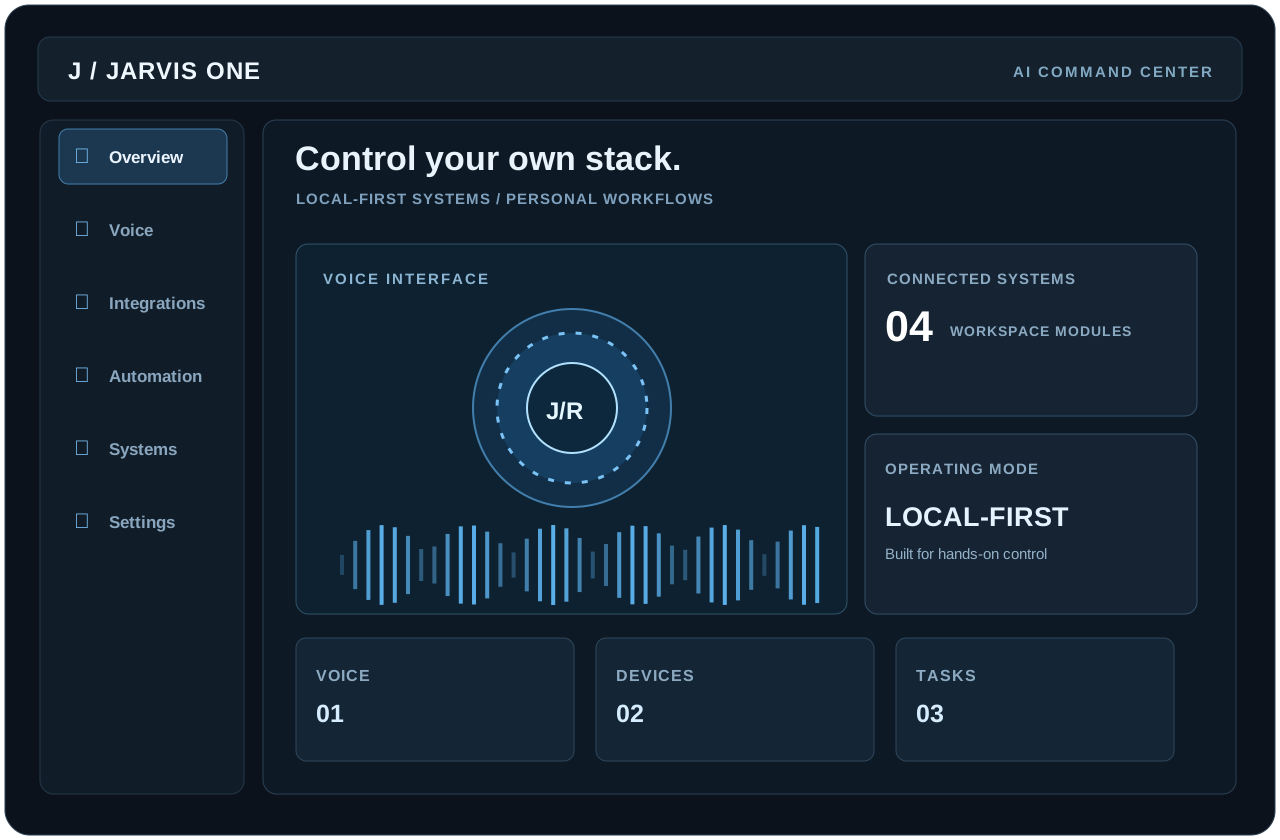
I like software that gives its owner control. That interest has led me to experiment with a personal assistant I call JARVIS—an interface for spoken commands, useful shortcuts and connected home or work systems. Running pieces of that workflow on local hardware can help with responsiveness and control over which information leaves the network.
Local does not automatically mean private or secure. A good setup still needs authentication, sensible permissions, logging decisions and careful handling of any external AI services.
Voice is an interface, not the whole product
A wake word and speech recognition are fun to build, but the important part is what happens after the request is understood. I want clear confirmations for meaningful actions, an easy way to correct misunderstood commands and the option to fall back to the dashboard when speaking is inconvenient.
A useful assistant should handle everyday friction. Asking for a device status, opening a workflow or checking a print is more compelling than a demo that only answers trivia.
Build a dashboard that explains the state
A dashboard should show whether the assistant is listening, which features are connected and what the last result actually was. That may sound less exciting than glowing visuals, but it makes experimentation much easier. I also like giving each integration its own settings so that setup does not require editing configuration files every time.
Clear error messages matter. A failed microphone permission, missing voice pack or unreachable device should have an actionable explanation.
Integrate carefully
Not every system belongs behind a voice command. Read-only status checks are a good place to start. Actions that could delete data, control physical equipment or expose private information should have stricter permissions and, where appropriate, explicit confirmations.
I think of an assistant as a collection of small, dependable capabilities rather than a single all-powerful command box.
Keep the experiments measurable
I want to know how often a command succeeds, how easy recovery is after failure and whether a feature genuinely saves time. Those are better measures of progress than the number of animations on the screen.
JARVIS remains an evolving personal experiment. I share these ideas as design notes, not as a claim that every planned integration is already production-ready.
Final thought: Every design has trade-offs. The useful part is recognizing them early, testing a workable solution and making the next version better.
These are general maker and software notes based on personal projects, not a guarantee that any particular design will suit a safety-critical application.
← Back to all articles